

Unlocking Liquidity for B2B Marketplaces
Unlocking Liquidity for B2B Marketplaces
Overview
In part one of this series, we have talked about the basics of venture debt, its benefits and risks, as they apply to early-stage startups. In this second part, we are taking a closer, vertical-specific look at how non-dilutive financing can play a central role for certain business models – in our case, these are B2B marketplaces and platforms, especially those that apply the so-called “Merchant of Record” (MoR) model.
Marketplace models: the deeper you go, the more you own
B2B marketplaces are platforms that connect corporate suppliers with corporate buyers. While they may look similar on the surface, the underlying models can look quite different. Over time, these models, be it B2C or B2B, have evolved from simple listing sites such as Craigslist, through SaaS-enabled-marketplaces, to complex MoR models.
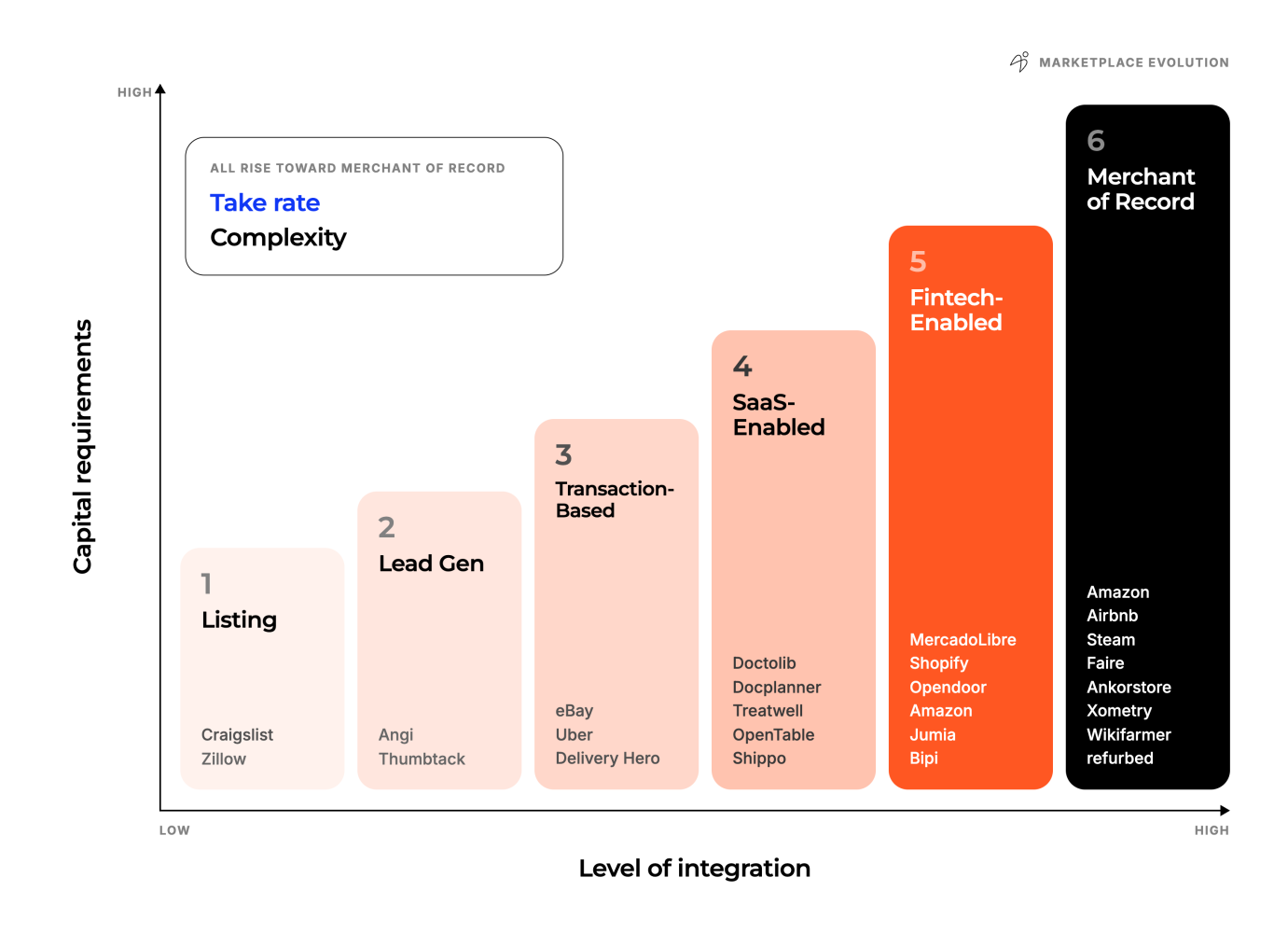
Initially, most marketplaces merely acted as a facilitator between the supply and demand side by providing a central place for listing offers (1) – think of Craigslist, for example. The main benefit was discoverability. The platform itself did not own any of the transactions.
Over time, the simple listing model evolved into lead generation (2): using the data at hand, platforms would actively match supply and demand, selling - often - pre-qualified leads to either side of the marketplace. This made the model more performance-based than its predecessor: instead of paying regardless of the outcome, customers of the lead generation model would only pay in case of a generated lead.
The next step in the evolution of marketplaces was the advent of transaction-based marketplaces (3) like eBay, Uber, or Delivery Hero. In this model, the marketplace would facilitate transaction execution and payment, in addition to discovery and matching.
SaaS-enabled models (4) took this approach a step further, and integrated into the daily operations of the merchant by providing operational software to manage workflows. They often follow the logic of “come for the tool, stay for the network”: the workflow management feature serves as a trojan horse to build up one side of the marketplace. This creates a lock-in to then kickstart the actual marketplace with at least one side of the platform already being present. Doctolib, for example, offers a platform for doctors and their practices to handle their calendar management, patient messaging, and secure document sharing. Patients use Doctolib to find and book appointments.
Fintech-enabled marketplaces (5) then embedded financial services directly into the platform, for example for lending, financing, payment infrastructure, or credit – typically using third-party providers like Billie or Mondu.
Marketplaces applying a Merchant of Record (MoR) model (6) are at the endpoint of that evolution. They take full financial and legal responsibility for the transaction: their name appears on the buyer's bank statement, and they typically handle taxes, refunds, chargebacks, and payment security. While they usually only take this risk on an existing closed-loop transaction, where they have matched a buyer and seller of a given product or service, it creates significant working capital challenges, especially in the context of B2B transactions.
MoR platforms: tackling cold starts with superior value propositions
Looking at the extensive responsibility, added risks, and increased working capital challenges – why bother launching a marketplace that follows the MoR model? Despite the operational overhead, this model enables a B2B marketplace to offer superior value propositions to its participants. Especially during the initial go-to-market motion, this superior value proposition helps newcomers to solve the cold-start problem (sometimes also referred to as the “chicken-and-egg” problem) that every marketplace faces in its early days.
A new marketplace needs to attract buyers as well as suppliers. The issue is that neither wants to show up first: buyers will only use the platform if there is attractive supply. Suppliers will want to have a sense of sufficient demand in order to actually have a choice and commit to an unproven marketplace. By taking full ownership of the entire process, MoR marketplaces can incentivize both sides to join by giving them benefits that go beyond mere discovery and matching, e.g., offering highly attractive payment terms like fast, cash-saving payments to the supply side and/or late, liquidity-preserving payments to the demand side. Additional value-add services such as insurance, logistics (e.g., free returns), quality assurance, tax submission, and reconciliation are further enhancing the value proposition, but they pose yet another strain on working capital.
Ultimately, these measures all have the same effect: parties that would not have made business with each other due to a lack of trust do so because they trust the marketplace as a reliable, third entity. In that sense, the MoR platform serves as a substitute for the lack of inter-party trust, because it has “skin in the game”.
The MoR moat: networks built on trust
Take Faire, for example, a wholesale marketplace connecting independent brands with local retailers. Dan Hockenmaier, Faire’s former Chief Strategy Officer, described the company’s strategy in a recent blog post:
“(...) Faire offered free returns and net 60 payment terms to retailers. That means they could try out a new product line for two months and send it back if it didn’t sell, all before paying us. Retailers loved it, but it was very expensive. (...) we would be able to offer something uniquely valuable to our customers, setting us apart from companies less willing to make the effort.”
– Dan Hockenmaier (former CSO, Faire)
This way, Faire was able to attract buyers and suppliers early on. But as we can see, the main effect of such a strategy is not only incentivization: it is to create trust for users of the platform. Trust is one of the key pillars every marketplace is built on. This is particularly important in cross-border B2B marketplaces connecting buyers and sellers that have never dealt with each other before, and especially relevant for industries where trust is essential for facilitating day-to-day transactions.
From MoR to industry-wide trust layer
Another example is a B2B marketplace for recycled plastics. The European recyclates market is growing fast – but has yet to reach its full potential. Recycled polymers are a complex, non-standardized material: the quality highly depends on the degree of contamination and degradation of the collected material. The market is still characterized by inconsistent quality, and data is scattered or missing. Without data, there is no trust, and without trust, there is no adoption.
In this instance, the platform acts as a principal that owns the material, finances the transaction, and conducts quality assurance. Batches are tested against the spec that the buyer has agreed to, generating quality and performance data. This way, the platform offers reliable quality and trustworthy data for industrial buyers. The team has implemented an agentic trading engine that learns from these growing data points, improving deal matching with each transaction, so that buyers get materials from different suppliers that actually fit their specifications and volume requirements. This is a good example of how MoR platforms build a competitive moat by absorbing liability, institutionalizing trust, and posing an objective authority.
Venture debt: a growth lever for MoR platforms?
Offering superior terms in order to build trust-based networks, however, comes at a cost: working capital is needed to provide consistent liquidity, because the platform is pre-financing transactions and passing down benefits to its users – every order means capital spent before the matching payment comes back in. Not only does the amount of liquidity determine the potential of such a platform to grow and expand, but it can also have a significant impact in winner-takes-most or winner-takes-all scenarios when speed is of the essence. Overall, this means that these marketplaces do have higher funding requirements. The main challenge becomes: how to finance such an initial momentum for a MoR marketplace?
The most obvious choice is equity. But financing these working capital requirements with equity could potentially lead to a significant dilution early on and it is the most expensive financing option a founder has. So rather than funding an MoR approach only with equity, it might make sense to raise debt instead or in addition to keep dilution balanced and find a repeatable, scalable way to maintain this competitive edge over time – all without having to raise more equity, but rather finance it with (venture) debt.
The importance of capital velocity
This dynamic makes the speed at which a MoR marketplace can turn over its debt just as important as the amount of debt it raises in the first place. The faster a platform collects on outstanding receivables – the quicker a retailer repays, or the sooner a payout cycle closes – the sooner that same capital becomes available to finance the next wave of orders. In effect, a fast cash conversion cycle acts as a multiplier on debt capacity: it allows a fixed amount of debt to finance a proportionally larger volume of GMV over the course of a year, without requiring the platform to raise additional capital.
This creates a genuine growth flywheel. As a marketplace accumulates more transaction history, it gains visibility into which buyers pay reliably, which categories carry the least risk, and where credit terms can be tightened or extended. This data feeds directly into better underwriting, which in turn reduces defaults and optimizes the cash conversion cycle even further. A faster, lower-risk repayment cycle then becomes the basis for accessing debt on better terms – larger facilities, lower interest rates – which allows the platform to pre-finance even more GMV/revenue. Each turn of the cycle reinforces the next, compounding capital efficiency over time, leading to a competitive advantage in itself.
Summary
As we have seen, venture debt is particularly interesting for B2B marketplaces that follow the MoR model. It can help solve the chicken-and-egg problem and expand a market by unlocking shadow supply or enabling business between parties that have never met before. Looking at the examples of Faire and the B2B marketplace for recycled plastics, it becomes clear how venture debt can act as a bridge that closes the gap between expenditure and revenue on the marketplace side, enabling better terms for customers, building trusted networks early on, and turning network effects into a sustainable moat. This way, a debt-driven financing strategy can generate a real competitive advantage.
However, venture debt is a tool that needs to be implemented carefully and that has downstream implications for any business. Make sure to catch up on part one of our debt financing series, where we dive into the benefits, risks, and lender landscape of venture debt.
If you are building an AI-native B2B marketplace yourself and are considering applying a MoR model, do not hesitate to get in touch with me.
Overview
In part one of this series, we have talked about the basics of venture debt, its benefits and risks, as they apply to early-stage startups. In this second part, we are taking a closer, vertical-specific look at how non-dilutive financing can play a central role for certain business models – in our case, these are B2B marketplaces and platforms, especially those that apply the so-called “Merchant of Record” (MoR) model.
Marketplace models: the deeper you go, the more you own
B2B marketplaces are platforms that connect corporate suppliers with corporate buyers. While they may look similar on the surface, the underlying models can look quite different. Over time, these models, be it B2C or B2B, have evolved from simple listing sites such as Craigslist, through SaaS-enabled-marketplaces, to complex MoR models.
Initially, most marketplaces merely acted as a facilitator between the supply and demand side by providing a central place for listing offers (1) – think of Craigslist, for example. The main benefit was discoverability. The platform itself did not own any of the transactions.
Over time, the simple listing model evolved into lead generation (2): using the data at hand, platforms would actively match supply and demand, selling - often - pre-qualified leads to either side of the marketplace. This made the model more performance-based than its predecessor: instead of paying regardless of the outcome, customers of the lead generation model would only pay in case of a generated lead.
The next step in the evolution of marketplaces was the advent of transaction-based marketplaces (3) like eBay, Uber, or Delivery Hero. In this model, the marketplace would facilitate transaction execution and payment, in addition to discovery and matching.
SaaS-enabled models (4) took this approach a step further, and integrated into the daily operations of the merchant by providing operational software to manage workflows. They often follow the logic of “come for the tool, stay for the network”: the workflow management feature serves as a trojan horse to build up one side of the marketplace. This creates a lock-in to then kickstart the actual marketplace with at least one side of the platform already being present. Doctolib, for example, offers a platform for doctors and their practices to handle their calendar management, patient messaging, and secure document sharing. Patients use Doctolib to find and book appointments.
Fintech-enabled marketplaces (5) then embedded financial services directly into the platform, for example for lending, financing, payment infrastructure, or credit – typically using third-party providers like Billie or Mondu.
Marketplaces applying a Merchant of Record (MoR) model (6) are at the endpoint of that evolution. They take full financial and legal responsibility for the transaction: their name appears on the buyer's bank statement, and they typically handle taxes, refunds, chargebacks, and payment security. While they usually only take this risk on an existing closed-loop transaction, where they have matched a buyer and seller of a given product or service, it creates significant working capital challenges, especially in the context of B2B transactions.
MoR platforms: tackling cold starts with superior value propositions
Looking at the extensive responsibility, added risks, and increased working capital challenges – why bother launching a marketplace that follows the MoR model? Despite the operational overhead, this model enables a B2B marketplace to offer superior value propositions to its participants. Especially during the initial go-to-market motion, this superior value proposition helps newcomers to solve the cold-start problem (sometimes also referred to as the “chicken-and-egg” problem) that every marketplace faces in its early days.
A new marketplace needs to attract buyers as well as suppliers. The issue is that neither wants to show up first: buyers will only use the platform if there is attractive supply. Suppliers will want to have a sense of sufficient demand in order to actually have a choice and commit to an unproven marketplace. By taking full ownership of the entire process, MoR marketplaces can incentivize both sides to join by giving them benefits that go beyond mere discovery and matching, e.g., offering highly attractive payment terms like fast, cash-saving payments to the supply side and/or late, liquidity-preserving payments to the demand side. Additional value-add services such as insurance, logistics (e.g., free returns), quality assurance, tax submission, and reconciliation are further enhancing the value proposition, but they pose yet another strain on working capital.
Ultimately, these measures all have the same effect: parties that would not have made business with each other due to a lack of trust do so because they trust the marketplace as a reliable, third entity. In that sense, the MoR platform serves as a substitute for the lack of inter-party trust, because it has “skin in the game”.
The MoR moat: networks built on trust
Take Faire, for example, a wholesale marketplace connecting independent brands with local retailers. Dan Hockenmaier, Faire’s former Chief Strategy Officer, described the company’s strategy in a recent blog post:
“(...) Faire offered free returns and net 60 payment terms to retailers. That means they could try out a new product line for two months and send it back if it didn’t sell, all before paying us. Retailers loved it, but it was very expensive. (...) we would be able to offer something uniquely valuable to our customers, setting us apart from companies less willing to make the effort.”
– Dan Hockenmaier (former CSO, Faire)
This way, Faire was able to attract buyers and suppliers early on. But as we can see, the main effect of such a strategy is not only incentivization: it is to create trust for users of the platform. Trust is one of the key pillars every marketplace is built on. This is particularly important in cross-border B2B marketplaces connecting buyers and sellers that have never dealt with each other before, and especially relevant for industries where trust is essential for facilitating day-to-day transactions.
From MoR to industry-wide trust layer
Another example is a B2B marketplace for recycled plastics. The European recyclates market is growing fast – but has yet to reach its full potential. Recycled polymers are a complex, non-standardized material: the quality highly depends on the degree of contamination and degradation of the collected material. The market is still characterized by inconsistent quality, and data is scattered or missing. Without data, there is no trust, and without trust, there is no adoption.
In this instance, the platform acts as a principal that owns the material, finances the transaction, and conducts quality assurance. Batches are tested against the spec that the buyer has agreed to, generating quality and performance data. This way, the platform offers reliable quality and trustworthy data for industrial buyers. The team has implemented an agentic trading engine that learns from these growing data points, improving deal matching with each transaction, so that buyers get materials from different suppliers that actually fit their specifications and volume requirements. This is a good example of how MoR platforms build a competitive moat by absorbing liability, institutionalizing trust, and posing an objective authority.
Venture debt: a growth lever for MoR platforms?
Offering superior terms in order to build trust-based networks, however, comes at a cost: working capital is needed to provide consistent liquidity, because the platform is pre-financing transactions and passing down benefits to its users – every order means capital spent before the matching payment comes back in. Not only does the amount of liquidity determine the potential of such a platform to grow and expand, but it can also have a significant impact in winner-takes-most or winner-takes-all scenarios when speed is of the essence. Overall, this means that these marketplaces do have higher funding requirements. The main challenge becomes: how to finance such an initial momentum for a MoR marketplace?
The most obvious choice is equity. But financing these working capital requirements with equity could potentially lead to a significant dilution early on and it is the most expensive financing option a founder has. So rather than funding an MoR approach only with equity, it might make sense to raise debt instead or in addition to keep dilution balanced and find a repeatable, scalable way to maintain this competitive edge over time – all without having to raise more equity, but rather finance it with (venture) debt.
The importance of capital velocity
This dynamic makes the speed at which a MoR marketplace can turn over its debt just as important as the amount of debt it raises in the first place. The faster a platform collects on outstanding receivables – the quicker a retailer repays, or the sooner a payout cycle closes – the sooner that same capital becomes available to finance the next wave of orders. In effect, a fast cash conversion cycle acts as a multiplier on debt capacity: it allows a fixed amount of debt to finance a proportionally larger volume of GMV over the course of a year, without requiring the platform to raise additional capital.
This creates a genuine growth flywheel. As a marketplace accumulates more transaction history, it gains visibility into which buyers pay reliably, which categories carry the least risk, and where credit terms can be tightened or extended. This data feeds directly into better underwriting, which in turn reduces defaults and optimizes the cash conversion cycle even further. A faster, lower-risk repayment cycle then becomes the basis for accessing debt on better terms – larger facilities, lower interest rates – which allows the platform to pre-finance even more GMV/revenue. Each turn of the cycle reinforces the next, compounding capital efficiency over time, leading to a competitive advantage in itself.
Summary
As we have seen, venture debt is particularly interesting for B2B marketplaces that follow the MoR model. It can help solve the chicken-and-egg problem and expand a market by unlocking shadow supply or enabling business between parties that have never met before. Looking at the examples of Faire and the B2B marketplace for recycled plastics, it becomes clear how venture debt can act as a bridge that closes the gap between expenditure and revenue on the marketplace side, enabling better terms for customers, building trusted networks early on, and turning network effects into a sustainable moat. This way, a debt-driven financing strategy can generate a real competitive advantage.
However, venture debt is a tool that needs to be implemented carefully and that has downstream implications for any business. Make sure to catch up on part one of our debt financing series, where we dive into the benefits, risks, and lender landscape of venture debt.
If you are building an AI-native B2B marketplace yourself and are considering applying a MoR model, do not hesitate to get in touch with me.

The Author










.png)
.jpg)






.jpg)
.jpg)

.jpg)












.png)


.jpg)
-min.png)


.jpg)


.jpg)