

Fixing Infrastructure’s Hardest Bottleneck – Why We Invested in Sitegeist
Fixing Infrastructure’s Hardest Bottleneck – Why We Invested in Sitegeist
Europe’s infrastructure is aging fast. Bridges, tunnels, parking structures, and public buildings urgently require renovation, yet progress is stalling. The reason is not a lack of capital or demand, but a structural bottleneck on site: critical renovation work still depends on scarce, highly skilled manual labor that is increasingly hard to find, train, and retain.
Concrete renovation is one of the clearest examples. Before structures can be reinforced or recoated, damaged concrete must be selectively removed using high-pressure water or abrasive blasting. This work is physically demanding, safety-critical, and highly individualized from site to site. Productivity is low, rework is costly, and retaining skilled workers is increasingly difficult. Many contractors are fully booked years in advance, not because demand is weak, but because capacity simply cannot scale.
In Germany alone, the infrastructure repair backlog runs into the hundreds of billions of euros, with similar dynamics across Europe and North America. At the same time, nearly four out of five construction firms report severe labor shortages. Without a fundamental productivity shift, critical infrastructure renewal will continue to fall behind.
A structural bottleneck meets technological readiness
For a long time, automation was not a viable answer. Construction sites vary significantly in layout, conditions, and workflows. Conventional robotics depends on pre-existing 3D models, standardized environments, and carefully controlled conditions, assumptions that rarely hold true in renovation projects.
What has changed is the convergence of urgency and capability. Hardware costs have fallen dramatically, compute and perception capabilities have matured, and real-world robotic systems can now operate reliably outside of controlled factory environments. At the same time, customer pull has become unmistakable: contractors are actively looking for solutions that allow them to scale capacity, improve safety, and deliver projects more reliably under growing workforce constraints.
Sitegeist: autonomy for real-world renovation sites
Sitegeist addresses this gap with the first ever specialized robotic systems that make large-scale concrete renovation scalable by automating safety-critical tasks that have traditionally depended on scarce, highly skilled manual labor, delivering immediate economic and operational impact for contractors.
The Munich-based company develops autonomous, AI-enabled, modular construction robots designed specifically for unstructured renovation environments. Unlike conventional automation approaches, Sitegeist’s systems operate directly on existing structures, without requiring prior digitization, BIM data, or standardized site conditions. Using autonomous perception, adaptive control, and a deliberately pragmatic autonomy stack, the robots can handle complex geometries and varying material conditions directly on site.
This enables immediate deployment on real renovation projects. Tasks such as concrete removal and abrasive blasting can be executed with consistent quality, significantly higher throughput, and reduced safety risk. In early deployments, Sitegeist’s systems have demonstrated up to a six-fold productivity increase compared to manual work, while maintaining the precision required to avoid damage to underlying steel reinforcement. At the same time, the system is built as a modular platform, allowing Sitegeist to extend automation across additional surface-treatment and renovation tasks over time.
Sitegeist is not positioned as a traditional equipment supplier. Instead, the company delivers clearly defined outcomes. Customers pay for measurable results, such as cubic meters of concrete removed or square meters of surface treated, within existing subcontracting workflows. This approach lowers adoption barriers and allows contractors to scale capacity without adding operational complexity.
A strong technical team with pragmatic execution
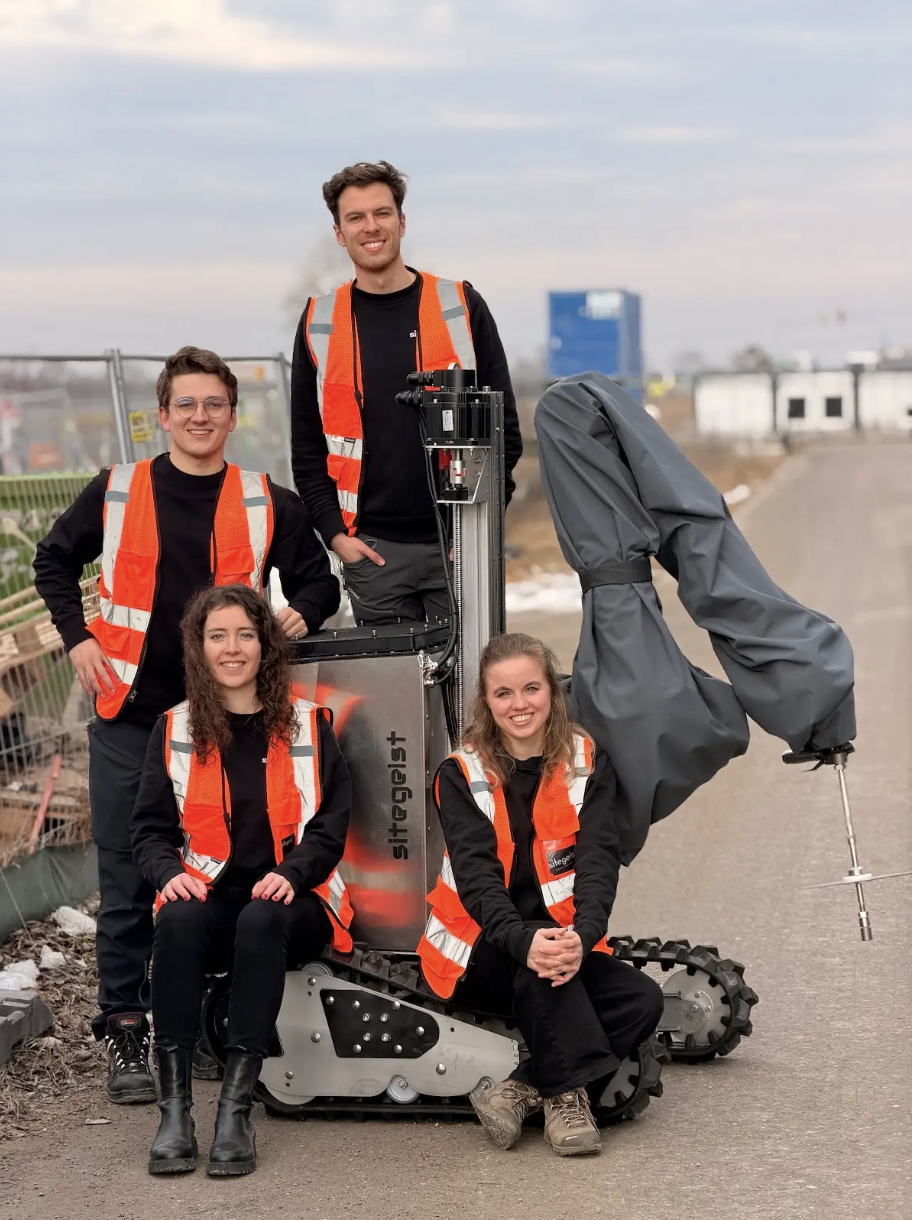
Sitegeist was founded by Dr. Lena-Marie Pätzmann (CEO), Julian Hoffmann (CTO), Nicola Kolb (COO), and Claus Carste (CPO), a team with deep expertise in robotics, AI, and autonomous systems. Originating from leading robotics research at TU Munich, they combine deep technical expertise with a pragmatic approach to real-world deployment.
The team focuses on solutions that can be deployed directly on construction sites, with minimal setup and robustness in harsh environments. From our first interactions, we were impressed by their clarity of focus, speed of execution, and grounded understanding of how renovation actually works on site.
Why we invested
At b2venture, we back teams building foundational technologies that unlock step-change productivity in large, traditionally hard-to-digitize industries. Construction, and infrastructure renovation in particular, is one of the most important and most overlooked of these sectors.
Sitegeist tackles a critical bottleneck with a solution that is technically differentiated, economically compelling, and driven by clear customer pull. By automating some of the most dangerous and labor-intensive tasks on site, the company enables contractors to scale capacity, improve safety, and deliver essential infrastructure projects faster and more reliably. The combination of a clear initial wedge and a scalable platform underpins our conviction that Sitegeist is positioned to define a new category in construction robotics.
We are proud to have co-led Sitegeist’s EUR 4m pre-seed round together with OpenOcean, alongside a strong group of angel investors and strategic backers from construction and robotics. We are excited to support Lena-Marie, Julian, Nicola, and Claus, and the entire Sitegeist team as they build the leading platform for autonomous concrete renovation and help close Europe’s growing infrastructure gap.
Europe’s infrastructure is aging fast. Bridges, tunnels, parking structures, and public buildings urgently require renovation, yet progress is stalling. The reason is not a lack of capital or demand, but a structural bottleneck on site: critical renovation work still depends on scarce, highly skilled manual labor that is increasingly hard to find, train, and retain.
Concrete renovation is one of the clearest examples. Before structures can be reinforced or recoated, damaged concrete must be selectively removed using high-pressure water or abrasive blasting. This work is physically demanding, safety-critical, and highly individualized from site to site. Productivity is low, rework is costly, and retaining skilled workers is increasingly difficult. Many contractors are fully booked years in advance, not because demand is weak, but because capacity simply cannot scale.
In Germany alone, the infrastructure repair backlog runs into the hundreds of billions of euros, with similar dynamics across Europe and North America. At the same time, nearly four out of five construction firms report severe labor shortages. Without a fundamental productivity shift, critical infrastructure renewal will continue to fall behind.
A structural bottleneck meets technological readiness
For a long time, automation was not a viable answer. Construction sites vary significantly in layout, conditions, and workflows. Conventional robotics depends on pre-existing 3D models, standardized environments, and carefully controlled conditions, assumptions that rarely hold true in renovation projects.
What has changed is the convergence of urgency and capability. Hardware costs have fallen dramatically, compute and perception capabilities have matured, and real-world robotic systems can now operate reliably outside of controlled factory environments. At the same time, customer pull has become unmistakable: contractors are actively looking for solutions that allow them to scale capacity, improve safety, and deliver projects more reliably under growing workforce constraints.
Sitegeist: autonomy for real-world renovation sites
Sitegeist addresses this gap with the first ever specialized robotic systems that make large-scale concrete renovation scalable by automating safety-critical tasks that have traditionally depended on scarce, highly skilled manual labor, delivering immediate economic and operational impact for contractors.
The Munich-based company develops autonomous, AI-enabled, modular construction robots designed specifically for unstructured renovation environments. Unlike conventional automation approaches, Sitegeist’s systems operate directly on existing structures, without requiring prior digitization, BIM data, or standardized site conditions. Using autonomous perception, adaptive control, and a deliberately pragmatic autonomy stack, the robots can handle complex geometries and varying material conditions directly on site.
This enables immediate deployment on real renovation projects. Tasks such as concrete removal and abrasive blasting can be executed with consistent quality, significantly higher throughput, and reduced safety risk. In early deployments, Sitegeist’s systems have demonstrated up to a six-fold productivity increase compared to manual work, while maintaining the precision required to avoid damage to underlying steel reinforcement. At the same time, the system is built as a modular platform, allowing Sitegeist to extend automation across additional surface-treatment and renovation tasks over time.
Sitegeist is not positioned as a traditional equipment supplier. Instead, the company delivers clearly defined outcomes. Customers pay for measurable results, such as cubic meters of concrete removed or square meters of surface treated, within existing subcontracting workflows. This approach lowers adoption barriers and allows contractors to scale capacity without adding operational complexity.
A strong technical team with pragmatic execution
Sitegeist was founded by Dr. Lena-Marie Pätzmann (CEO), Julian Hoffmann (CTO), Nicola Kolb (COO), and Claus Carste (CPO), a team with deep expertise in robotics, AI, and autonomous systems. Originating from leading robotics research at TU Munich, they combine deep technical expertise with a pragmatic approach to real-world deployment.
The team focuses on solutions that can be deployed directly on construction sites, with minimal setup and robustness in harsh environments. From our first interactions, we were impressed by their clarity of focus, speed of execution, and grounded understanding of how renovation actually works on site.
Why we invested
At b2venture, we back teams building foundational technologies that unlock step-change productivity in large, traditionally hard-to-digitize industries. Construction, and infrastructure renovation in particular, is one of the most important and most overlooked of these sectors.
Sitegeist tackles a critical bottleneck with a solution that is technically differentiated, economically compelling, and driven by clear customer pull. By automating some of the most dangerous and labor-intensive tasks on site, the company enables contractors to scale capacity, improve safety, and deliver essential infrastructure projects faster and more reliably. The combination of a clear initial wedge and a scalable platform underpins our conviction that Sitegeist is positioned to define a new category in construction robotics.
We are proud to have co-led Sitegeist’s EUR 4m pre-seed round together with OpenOcean, alongside a strong group of angel investors and strategic backers from construction and robotics. We are excited to support Lena-Marie, Julian, Nicola, and Claus, and the entire Sitegeist team as they build the leading platform for autonomous concrete renovation and help close Europe’s growing infrastructure gap.

The Author

Team











.png)
.jpg)




.jpg)
.jpg)
.jpg)











.png)


.jpg)
-min.png)


.jpg)


.jpg)